
The Los Angeles City Council’s Information Technology and General Services (ITGS) Committee on Tuesday
Blog Post
L.A. Council committee signs off on Google email plan with caveats

Blog Post
The Los Angeles City Council’s Information Technology and General Services (ITGS) Committee on Tuesday
Blog Post

A Los Angeles City Council committee on Tuesday takes up a …
News Clipping

When the online advertising industry recently issued seven principles to protect consumer privacy, you could see the lines being drawn. John Simpson, consumer advocate for California-based nonprofit Consumer
Watchdog, doesn’t believe this industry will be able to regulate
itself. He believes opting in should be consumers’ choice, not the current
model where they have to work to opt out of having their Web-surfing
habits monitored. He says that if advertisers clearly explain their
programs and how that benefits customers, those users are likely to be
willing to be part of it.
Blog Post

What do you do if you’re a gargantuan Internet company that’s come under increased scrutiny, despite your "Don’t-be-evil" mantra? Send in the…
News Clipping

When Google meets with Congressional staffers, hoping to convince US lawmakers that it’s nothing but good for the world, the web giant likes to say that it believes in openness. "Open is better than closed, “the company says. Open "enhances competition" and "encourages innovation.” But if you ask the company to discuss its openness, it’s not too open about it. Late last week, the consumer watchdog known only as Consumer Watchdog
uncovered the canned pitch that Google recently launched at Capitol Hill in an effort to re-spin itself.
News Clipping

(Semi-)Apology For Money-Snuffing Missive
San Francisco, CA — Google has attempted to cut the funding of a
well-known public watchdog, after the organization launched a
"guerrilla" attack on its Washington lobby operation.
Blog Post
Google’s corporate motto is still "Don’t be evil", but folks just don’t trust the Internet…
Blog Post

The Wall Street Journal touched off a debate Monday in an article suggesting that Internet giant …
Blog Post

Google’s arch-rival, Mircrosoft, has just announced it will anonymize all private data it collects during online searches after six months if its competitors do the same thing.
As explained by …
News Clipping
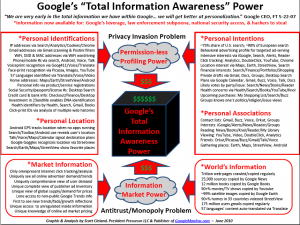
Perhaps the biggest threat to Google Inc.’s increasing dominance of Internet search and advertising is the rising fear, justified or not, that Google’s broadening reach is giving it unchecked power. "Google Suggest" sends Google searches as you type, in hopes of
anticipating your desires. So if you’re keying in "Electoral College
2008 election," Google will offer multiple search queries along the
way. First you’d be given results related to the term "electoral," then
ones on the Electoral College in general, and finally you’d get links
pertaining to Tuesday’s presidential vote. This is what worries
Consumer Watchdog: Say you key in something that could be embarrassing
or deeply personal, but reconsider before you press "Enter." The
autosuggest feature still sends this phrase to Google’s servers, tied
to your computer’s numeric Internet Protocol (IP) address.